Diet & Digestion
Cooking oils: the classical selections and the current evidence
Ayurveda assigns properties to different oils and recommends them for different constitutions. Nutrition science asks different questions, and the answers do not entirely align.
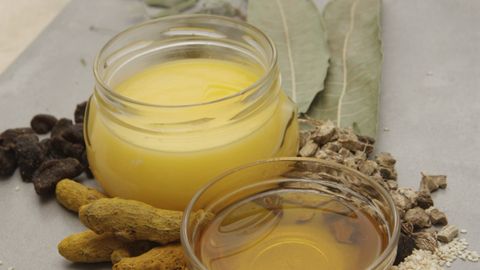
Classical texts describe several oils and assign properties to each — sesame as warming and suitable for vata, coconut as cooling, mustard as heating and penetrating, ghee as suitable in a wide range of conditions.
Contemporary nutrition asks about fatty acid composition, oxidative stability under heat, and effects on cardiovascular risk. The two frameworks address different questions.
The oils in the classical repertoire
Sesame oil. Prominent in classical use, both internally and for abhyanga. Predominantly unsaturated, with a mixture of monounsaturated and polyunsaturated fats. Reasonably stable to heat. Contains sesamin and sesamol, compounds with antioxidant properties which contribute to its stability.
Coconut oil. Predominantly saturated, and the most contested. Its saturated fat is largely medium-chain, which is metabolised somewhat differently from longer-chain saturated fat.
The evidence: coconut oil raises LDL cholesterol relative to unsaturated oils, which meta-analyses have consistently found. It also raises HDL. Health bodies generally recommend limiting it in the same way as other saturated fats.
The enthusiasm for coconut oil in recent years ran well ahead of the evidence, and reviews assessing it have generally not supported the health claims made.
Mustard oil. Widely used in eastern and northern India. High in monounsaturated fat and containing a reasonable proportion of alpha-linolenic acid, a plant omega-3.
The complication is erucic acid, which mustard oil contains in substantial quantity. Animal studies raised concerns about cardiac effects, and mustard oil is restricted for edible use in several countries on this basis. Human evidence of harm at typical dietary intakes is limited, and low-erucic varieties exist.
Some epidemiological work in India has associated mustard oil use with favourable outcomes, which complicates the picture further. The honest position is that this is unresolved.
Ghee. Discussed separately on this site. High in saturated fat, high smoke point, keeps without refrigeration.
What contemporary evidence supports
The general finding, from a large body of research, is that replacing saturated fat with unsaturated fat — particularly polyunsaturated — is associated with reduced cardiovascular events.
Olive oil has the most extensive evidence base of any single oil, largely through trials of Mediterranean dietary patterns where it is a central component.
Oils high in polyunsaturated fat, including sunflower, safflower, soybean and rapeseed, have evidence supporting their use in place of saturated fat, and the campaign against seed oils in popular media does not reflect the state of the evidence.
The most defensible position is to use predominantly unsaturated oils, to include some sources of omega-3, and to limit saturated fat.
Smoke point and heating
Practically relevant and frequently misunderstood.
Smoke point is the temperature at which an oil begins to break down visibly. Heating oil past this produces degradation products and unpleasant flavours.
Oils with high smoke points suit high-heat cooking: ghee, refined oils generally, and some unrefined oils.
Unrefined and cold-pressed oils generally have lower smoke points, because the compounds that give them flavour and colour are the ones that degrade first. They suit lower-temperature cooking and finishing.
Oxidative stability is a separate consideration from smoke point. Highly polyunsaturated oils are more prone to oxidation, particularly with prolonged heating or repeated reuse.
Repeatedly reused frying oil is the genuine concern, producing degradation products with documented adverse effects. This is a real and widespread practice in commercial frying and it is worth avoiding at home.
The classical instructions that hold up
Freshly prepared food. Reduces exposure to oxidised fats.
Not reusing oil, which several traditional sources advise.
Different oils for different purposes, which corresponds to smoke point and flavour considerations even though the reasoning offered differs.
Moderation in quantity. Fat is energy-dense, and the quantity used in cooking is a substantial contributor to total energy intake.
A practical approach
Use a mix rather than a single oil. Something with a high smoke point for higher-heat cooking, something unsaturated as the workhorse, and something flavourful for finishing.
Include an omega-3 source — oily fish, or plant sources such as flaxseed, walnut or mustard oil for those not eating fish.
Do not reuse frying oil repeatedly.
Keep oils in a cool dark place, since light and heat accelerate oxidation, and discard oil that smells rancid.
Moderate the quantity, whichever oil it is.
The proportion point
Which oil you use matters considerably less than the overall dietary pattern.
Someone eating plenty of vegetables, legumes, whole grains and fish, cooking at home, is in good shape whichever of these oils they use. Someone eating a diet high in refined carbohydrate and processed food will not be rescued by their choice of oil.
The oil argument absorbs more attention than the effect size warrants, in both traditional and contemporary framings.
Anyone with elevated cholesterol or cardiovascular disease should follow the dietary advice of their treating clinician.
Also by Meera Kulkarni
- Breath practice for anxiety: the specific thing to doYoga & Breath
- Drinking with meals, and the classical instructions about waterDiet & Digestion
- The evening routine and winding downDaily Routine
- Honey: the classical instructions and the evidenceDiet & Digestion