Diet & Digestion
Ghee and the fat question
Ghee occupies a central place in Ayurvedic dietetics and it is nearly pure saturated fat, which puts traditional recommendation and cardiovascular guidance in tension.

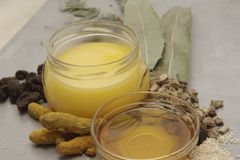
Ghee — butter clarified by heating to remove water and milk solids — is described in classical Ayurvedic texts in strongly favourable terms, recommended for a wide range of purposes and used both as food and as a vehicle for preparations.
It is also approximately pure fat, of which around two thirds is saturated. That is worth stating plainly at the outset.
What ghee is
Butter is heated until the water evaporates and the milk solids separate and are removed, leaving butterfat.
The result has a higher smoke point than butter, which makes it useful for cooking at higher temperatures. It keeps without refrigeration for long periods, which was the original practical advantage in a hot climate before refrigeration.
Removing the milk solids removes most of the lactose and casein, which means many people who react to dairy tolerate ghee. That is a genuine and useful property, though anyone with a severe milk allergy should be cautious, since trace protein may remain.
The classical position
The texts describe ghee as beneficial for digestion, for the eyes, for the tissues generally, and as particularly suitable for pitta and vata conditions. Aged ghee is described as having additional properties.
It is also used as an anupana — a vehicle carrying other preparations — on the basis that fat-soluble constituents are better delivered in it. That has a reasonable basis: fat-soluble compounds are better absorbed with fat present, which is straightforward pharmacology.
What nutrition science says about the fat
Ghee is roughly sixty to seventy percent saturated fat.
Dietary guidelines in essentially every country recommend limiting saturated fat intake, on the basis of evidence that it raises LDL cholesterol and that LDL is causally related to cardiovascular disease.
That evidence base has been the subject of genuine scientific debate over the past decade. Some meta-analyses of observational studies have not found a clear association between saturated fat intake and cardiovascular events, which has been widely reported.
The more careful reading is that what matters is what replaces it. Studies substituting saturated fat with polyunsaturated fat generally show cardiovascular benefit; substituting with refined carbohydrate generally does not. Major reviews and guideline bodies have maintained the recommendation to limit saturated fat while acknowledging the nuance.
Specific studies on ghee have produced mixed results, some suggesting less unfavourable lipid effects than expected. These studies are small and do not overturn the general position.
The heated ghee question
One point that deserves attention. Prolonged or repeated heating of ghee produces oxidised cholesterol products, and some research has raised concerns about these.
The practical implication is to avoid repeatedly reheating fat, which is sensible advice for any cooking fat.
How to hold the two positions
The tension is real and it should not be resolved by ignoring one side.
What can be said:
Quantity matters enormously. A teaspoon of ghee on a meal is a small contribution to daily saturated fat. Using it as the primary cooking fat in quantity is a substantial one.
The whole diet matters more than any ingredient. Ghee within a diet high in vegetables, legumes, whole grains and fish is a different proposition from ghee within a diet high in refined carbohydrate and processed food.
Individual circumstances matter. Anyone with elevated LDL cholesterol, established cardiovascular disease, familial hypercholesterolaemia or diabetes has a stronger reason to limit saturated fat, and should follow their clinician's advice rather than traditional dietary recommendations.
The classical recommendations were made for a population with a different overall diet, different activity levels and different life expectancy, and the texts themselves specify quantities and circumstances rather than recommending unlimited use.
The reasonable practice
Ghee is a pleasant cooking fat with useful properties — high smoke point, keeps well, tolerated by many people who react to dairy, and it tastes good.
Using it in moderate quantity, alongside unsaturated fats such as olive oil, mustard oil or seed oils, is a reasonable position that does not require choosing sides in the saturated fat argument.
Using it in large quantity because a traditional text praises it, while having elevated cholesterol, is not.
If you have raised cholesterol, cardiovascular disease or diabetes, follow the dietary advice of your treating clinician. Do not increase saturated fat intake on the basis of traditional recommendation without discussing it.
Also by Meera Kulkarni
- Breath practice for anxiety: the specific thing to doYoga & Breath
- Cooking oils: the classical selections and the current evidenceDiet & Digestion
- Drinking with meals, and the classical instructions about waterDiet & Digestion
- The evening routine and winding downDaily Routine