Herbs & Formulations
Tulsi: the household plant with a modest research file
Holy basil is grown in courtyards across India and used domestically for coughs and colds. The clinical evidence is thinner than its cultural presence suggests.
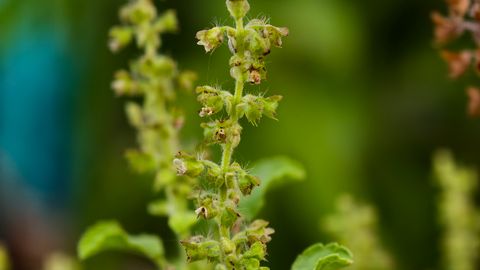
Ocimum tenuiflorum, tulsi or holy basil, occupies an unusual position — a plant with religious significance, grown domestically in enormous numbers of households, and used routinely for minor ailments.
That cultural presence means it is frequently discussed as though it were well established medicinally. The research picture is more modest.
Traditional use
Classical and folk use includes preparations for cough, cold, fever, digestive complaints and as a general tonic. Leaves are chewed, brewed as tea, or combined with honey and other ingredients in household preparations.
It is described in the rasayana category and is associated in contemporary popular material with the adaptogen concept — a term originating in twentieth-century Soviet research rather than in Ayurveda, and one with a loose and contested definition.
What has been studied
Stress and mood. A number of small randomised trials report reductions in stress scores. Reviews have noted that the studies are small, of short duration, mostly from a limited number of centres, and generally at risk of bias.
Glycaemic parameters. Several small trials in people with type 2 diabetes report reductions in fasting glucose. Sample sizes are small and the studies are old in several cases. This is not a basis for using tulsi in place of prescribed diabetes treatment.
Lipids. Some studies report changes in cholesterol measures. Inconsistent.
Immune and respiratory outcomes. Studies exist, mostly small, with mixed results.
Laboratory studies report antimicrobial, anti-inflammatory and antioxidant activity extensively. As always, this describes activity in cells and test tubes and does not establish clinical effect.
Systematic reviews of tulsi have generally concluded that the human evidence, while suggestive across several domains, is limited in quantity and quality and that larger, better-designed trials are needed.
Safety considerations
Culinary and traditional household use — a few leaves, or tea — has a long history and no substantial safety signal.
Concentrated extracts warrant more care, and several specific points are worth knowing.
Anticoagulant effects. Some evidence suggests antiplatelet activity. Relevant for anyone on anticoagulant or antiplatelet medication and before surgery.
Blood glucose. If it does lower glucose, that matters for anyone on diabetes medication, where additive effects could produce hypoglycaemia. Discuss with a prescriber.
Fertility. Animal studies have raised questions about effects on fertility and on sperm parameters at high doses. The human relevance is unclear, and it is a reason for caution for anyone trying to conceive.
Pregnancy. Insufficient safety data; avoidance of concentrated preparations is the standard advice.
Thyroid. Some evidence of effects on thyroid hormone levels in animal studies. Caution for anyone with thyroid disease.
The general problem this illustrates
Tulsi is a good example of a plant whose cultural prominence far exceeds its evidence base, and of how easily the two get conflated.
Long traditional use establishes that a substance has been consumed by many people over a long period, which is genuinely reassuring about gross toxicity at traditional doses in traditional preparations.
It does not establish efficacy for any particular purpose, and it does not transfer to concentrated modern extracts at doses that traditional use never involved.
That distinction — between traditional use as safety evidence and traditional use as efficacy evidence — is one of the more useful things to hold onto when reading about any herbal product.
The reasonable position
Tulsi tea is a pleasant drink with a long domestic history and no meaningful risk at that level of consumption.
Concentrated supplements are a different proposition, with limited efficacy evidence and a set of interaction concerns that are not trivial for anyone on medication.
For the conditions it is most often marketed for — stress, blood sugar, immunity — the interventions with better evidence are the unglamorous ones, and any decision to use a supplement alongside treatment for a diagnosed condition should involve the clinician treating it.
Do not use tulsi or any herbal preparation in place of prescribed treatment for diabetes or any other condition. Tell your doctor about supplements you take, particularly before surgery or if you take anticoagulants or diabetes medication.
Also by Sanjay Iyer
- The placebo question, taken seriouslyEvidence Watch
- Diuretic herbs and the kidneyHerbs & Formulations
- Yoga injuries and how to practise without acquiring oneYoga & Breath
- Arjuna and the heart claimsHerbs & Formulations