Herbs & Formulations
Shilajit: what it is, and the contamination question
A mineral-rich substance collected from rock faces, with a small research literature and a quality control problem that follows directly from what it is.
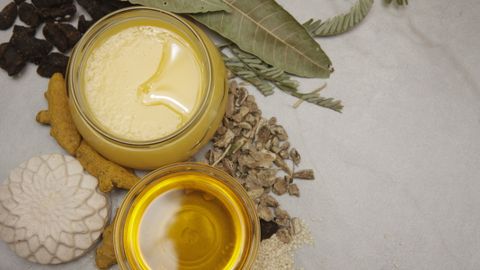
Shilajit is a dark, tar-like substance that exudes from rock in mountain regions, principally the Himalaya, Altai and Caucasus.
It is understood to form over long periods from decomposed plant material compressed in rock, and it contains humic and fulvic acids along with a range of minerals.
Classical Ayurveda classifies it as a rasayana and uses it for a range of purposes, particularly relating to vitality and to urinary and reproductive conditions.
The quality problem
This needs stating early, because it follows directly from the nature of the material.
Shilajit is collected from natural rock formations. Its composition varies with source, and it can contain heavy metals — lead, arsenic, mercury — depending on the geology of the collection site.
Classical texts describe purification procedures for exactly this reason, and traditional processing is intended to remove impurities.
Testing of commercial shilajit products has found substantial variation in composition and, in some analyses, heavy metal content exceeding acceptable limits.
Additionally, the market includes adulterated and entirely counterfeit products, since the raw material is expensive and difficult to authenticate visually.
Anyone considering shilajit should insist on third-party heavy metal testing with results available. Given what the substance is, this is not an optional precaution.
What has been studied
The clinical literature is small.
Male fertility and testosterone. A small number of trials report changes in hormonal and semen parameters. Sample sizes are small and independent replication is limited.
Fatigue and physical performance. Small studies with mixed results.
Altitude sickness, where traditional use is described and clinical evidence is essentially absent.
Cognitive function, with preliminary studies.
Laboratory studies of fulvic acid and of shilajit constituents report a range of activities. As always, this does not establish clinical effect.
Reviews have generally described the evidence as preliminary and called for larger trials.
Safety considerations
Heavy metals, as above, which is the principal concern.
Iron content. Shilajit contains iron, and anyone with haemochromatosis or iron overload should avoid it.
Gout and uric acid. Some sources advise caution given potential effects on uric acid, relevant for anyone with gout.
Pregnancy and breastfeeding. Insufficient data; avoid.
Children. Not appropriate without medical supervision.
Unprocessed material. Raw shilajit should not be consumed; traditional preparation involves purification, and products should be processed.
The sustainability question
Worth noting. Shilajit is a slowly formed natural material collected from specific locations, and demand has risen substantially with international marketing.
Collection pressure on Himalayan sources has been raised as a concern, along with the broader issue of over-harvesting affecting several medicinal plant species.
This applies well beyond shilajit — a number of Ayurvedic botanicals are under pressure in the wild, and several are formally assessed as threatened. Cultivated rather than wild-collected sources are preferable where available.
The general point about mineral preparations
Shilajit sits near the boundary between herbal and mineral preparations, and it is worth restating the position on the latter.
Rasa shastra preparations — bhasmas containing processed metals and minerals — are a distinct branch of classical Ayurvedic pharmacy. They contain metals by design, including in some cases mercury, lead and arsenic.
The tradition holds that processing renders them safe and therapeutically active. That has not been demonstrated by the standards applied to any other medicine, and cases of heavy metal poisoning associated with these products are documented.
Our position on this site is that these preparations should not be used except under the supervision of a clinician who will monitor blood levels, and that most people should avoid them.
Shilajit is not a bhasma and the contamination risk means the same testing discipline applies.
The reasonable assessment
A traditional substance with a small preliminary research literature, an inherent contamination risk arising from its nature and source, and a market with documented quality problems.
For the purposes it is most marketed for — energy, testosterone, performance — the evidence is thin and the interventions with better evidence are the usual ones.
If you use it, buy only tested product, and tell your doctor.
Insist on third-party heavy metal testing. Avoid if you have iron overload, are pregnant or breastfeeding. Do not give to children. Ask your doctor about blood lead testing if you have used untested traditional mineral preparations regularly.
Also by Sanjay Iyer
- The placebo question, taken seriouslyEvidence Watch
- Diuretic herbs and the kidneyHerbs & Formulations
- Yoga injuries and how to practise without acquiring oneYoga & Breath
- Arjuna and the heart claimsHerbs & Formulations